
Identifying your next one-million-unit item
By Nancy Marino, Associate Partner, Columbus Consulting

The Traditional Role of Assortment Planning
For decades, assortment planning has been viewed primarily as the discipline that translates merchandising strategy into a structured buy: determining what products to carry, how many choices to offer, how deeply to buy them, and how to distribute those choices across channels, stores, regions, and customer segments. That definition is no longer sufficient.
In today’s retail environment, assortment planning has the potential to become one of the retailer’s most powerful growth engines. Why? Because growth ultimately depends on the retailer’s ability to put the right product, in the right quantity, in the right place, at the right time—and recognize opportunities to sell substantially more when demand exceeds expectations.
The New Role of Assortment Planning
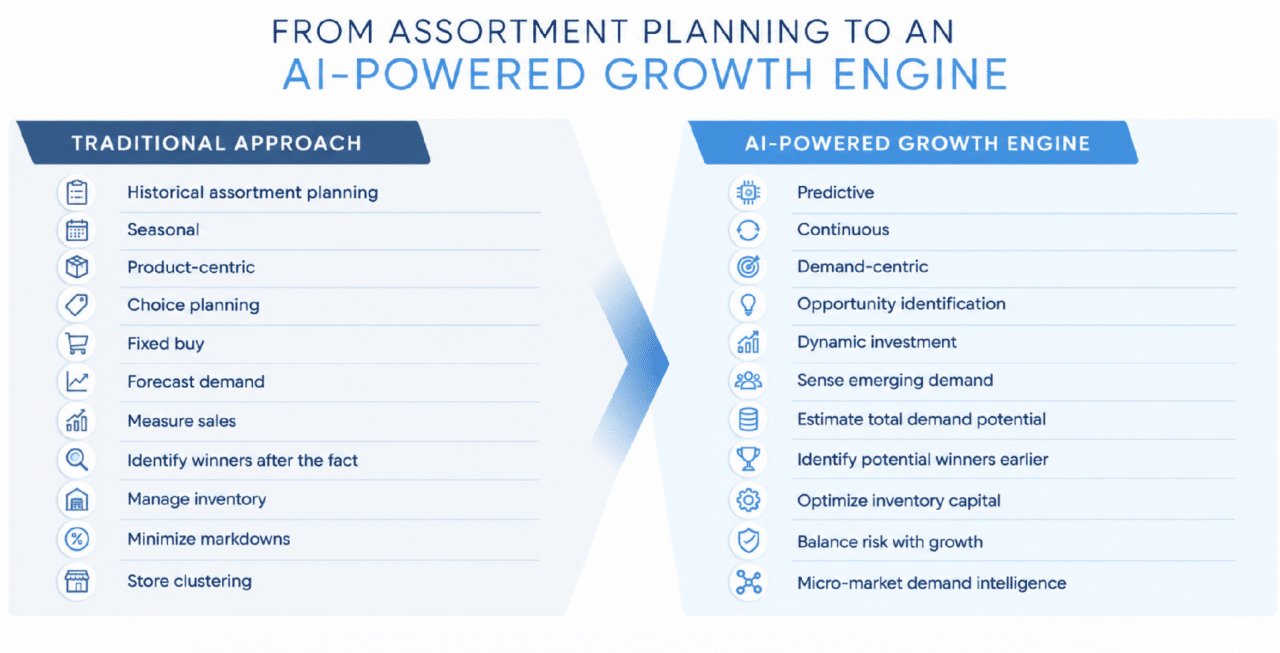
AI can transform assortment planning from a largely seasonal, historically based process into a continuous intelligence capability that identifies demand opportunities, predicts potential winners, detects assortment white space, optimizes inventory investment, and helps merchants determine where incremental growth can be captured. The question for assortment planning is therefore changing from “What should we buy?” To “Where is the growth opportunity, and how do we maximize it?”
Artificial intelligence fundamentally expands the ability for growth
AI allows retailers to move beyond historical sales and traditional forecasting to analyze thousands of signals across products, attributes, customers, stores, channels, markets, competitors, trends, digital behavior, and real-time demand. The result is a new generation of assortment planning focused not simply on building the right assortment, but on discovering and capturing growth.
Assortment Planning + AI = Growth Engine
The new assortment planning growth engine can be expressed through five actions:
- FIND — Identify hidden demand, emerging trends, assortment white space, and potential breakout products.
- FUND — Direct inventory investment toward the products and opportunities with the greatest potential.
- CHASE — Recognize emerging winners early enough to increase inventory, production, or distribution.
- CAPTURE — Convert as much potential demand as possible into actual sales.
- GROW — Continuously reinvest learning and inventory dollars into the next opportunity.
THIS CREATES ON CONTINUOUS CIRCLE:
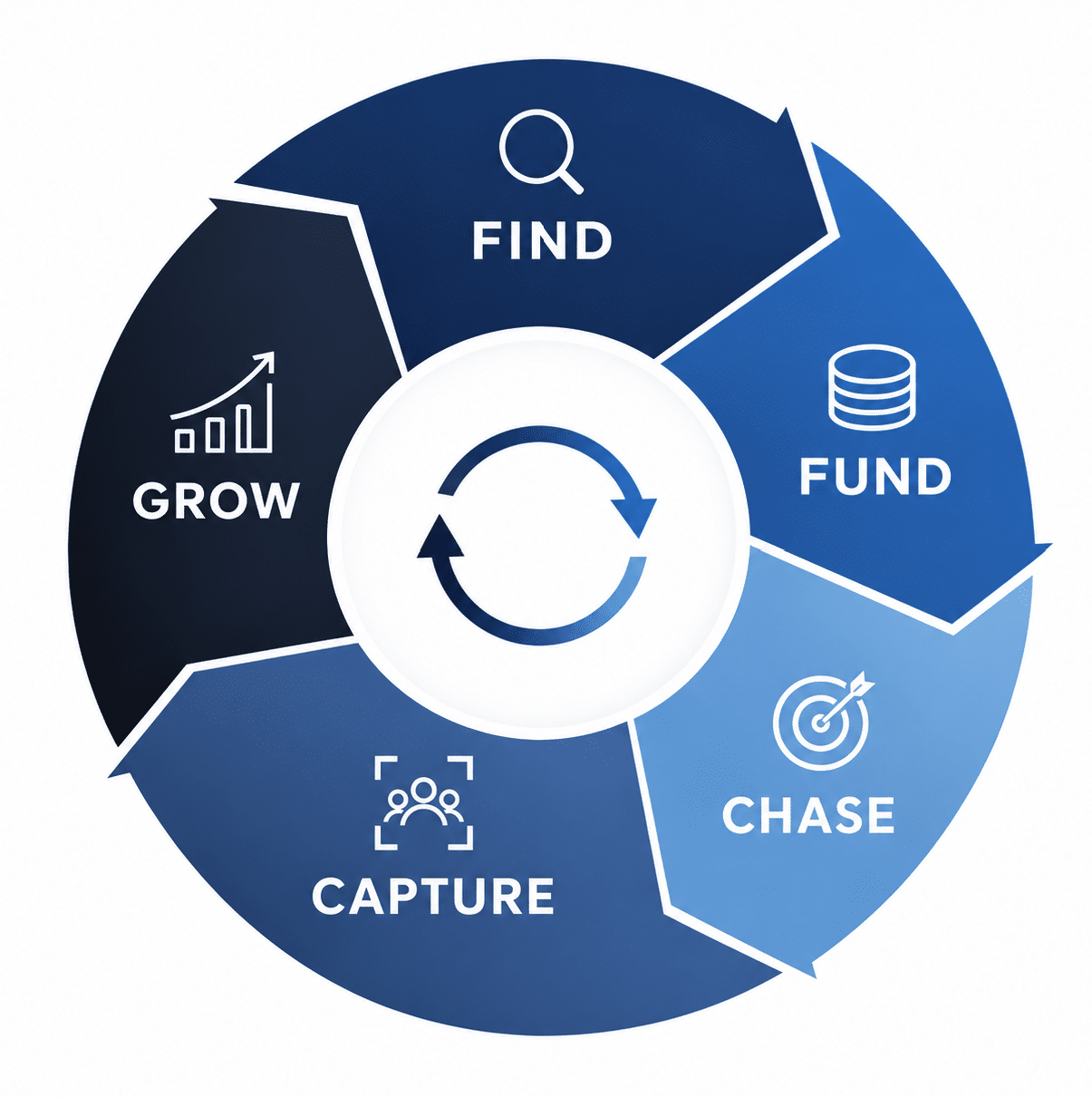
AI becomes the intelligence running through the entire engine. It helps the retailer determine not only what happened, but what could happen next and what actions could produce a better outcome. The ultimate measure of assortment planning therefore, changes as well. Success is no longer simply: Did we achieve the plan? It becomes: Did we maximize the growth opportunity?
That is why the next generation of assortment planning must look beyond traditional measures of inventory productivity toward a new concept:
The most expensive sale is the one you never had.

Your Next Million-Unit Item
Retailers devote enormous attention to markdowns, overstocks, inventory turns, and slow sellers. Those problems are highly visible. Lost demand is not.
Consider a product with the potential to sell one million units. Suppose the retailer buys 250,000 units and sells nearly all of them. Traditional performance measures might classify the product as an extraordinary success. Sell-through was excellent. Inventory productivity was strong. Markdown exposure was minimal. But those measures overlook the most important question: Could the retailer have sold one million units?
One of assortment planning’s greatest opportunities is identifying the products capable of dramatically outperforming expectations. Every retailer has these products. The problem is that they are often obvious only after they have become winners. By then, the growth opportunity may already have been constrained by inventory. AI can change the timing of that recognition.
Imagine an assortment containing 2,000 products. AI could continuously evaluate those products across hundreds of demand signals. It might identify that one new item combines several characteristics associated with unusually high potential:
- a rapidly growing silhouette
- a high-performing fabrication
- an emerging color
- a compelling price-value relationship
- strong digital engagement
- high conversion
- positive early customer response
- exceptional performance in leading stores or customer segments
Individually, these signals may not justify a major change to the buy. Collectively, they could indicate something much more significant: This could be the next million-unit item.
Ask yourself how much demand existed—and how much was captured?
Finding Growth in the White Space

Some of the retailer’s greatest opportunities may not exist in the current assortment at all. Consumers cannot buy a product that the retailer never offered. AI can analyze search behavior, customer preferences, competitive assortments, product attributes, price points, trend signals, and historical demand to identify potential gaps. A retailer might discover unmet demand for:
- a successful silhouette at a different price point
- additional colors of a winning product
- an extended size range
- a product attribute rapidly gaining customer interest
- or a product combination frequently searched for but poorly represented in the assortment
This gives assortment planning an important new role upstream. Instead of simply determining how much to buy, assortment intelligence can help influence what should be created. The growth engine, therefore, begins operating before the assortment even exists.
Assortment planning is no longer simply about managing inventory. It is about identifying where the retailer should place its bets, recognizing when those bets are winning, and having the intelligence and agility to increase the investment while the opportunity still exists or even before it exists. The retailers that master this capability will not simply plan better assortments. They will find growth their competitors miss, invest behind winners earlier, capture more demand, and generate greater returns from every inventory dollar.
Learn more about AI and AI-enabled retail here.
ABOUT COLUMBUS CONSULTING
For over 25 years, Retailers and Brands have relied on Columbus Consulting’s industry expertise, proven methodologies, and program leadership to transform businesses. Our global team works across functional areas to shape and deliver desired results with tangible returns.
From Retail for Retail…We are experienced retail operators who have ‘sat in the same seats’ as our clients. Today, we operate as extensions of the client, bringing expertise and bandwidth to execute programs. Consulting teams are curated for each client, leveraging our deep retail expertise and talent.
Columbus Consulting remains at the forefront of the retail industry. As retail continues to evolve with AI, our team of experts provides insights and solutions to advance each client’s performance and profitability. We know what challenges they face and have a track record with over 400 retailers.
We work across all retail segments from Luxury to Big Box, Apparel to Grocery. Our expertise includes: digital transformation & unified commerce, merchandising & category management, planning & inventory management, sourcing & supply chain, data & analytics, accounting, finance & operations, people & organization, and information technology & artificial intelligence.
From strategy to implementation, let us know how we can help. www.columbusconsulting.com