
Taking Stock of Retail in the Era of Intelligent Inventory & How the Next Generation of Retail is Heading Towards Autopilot.
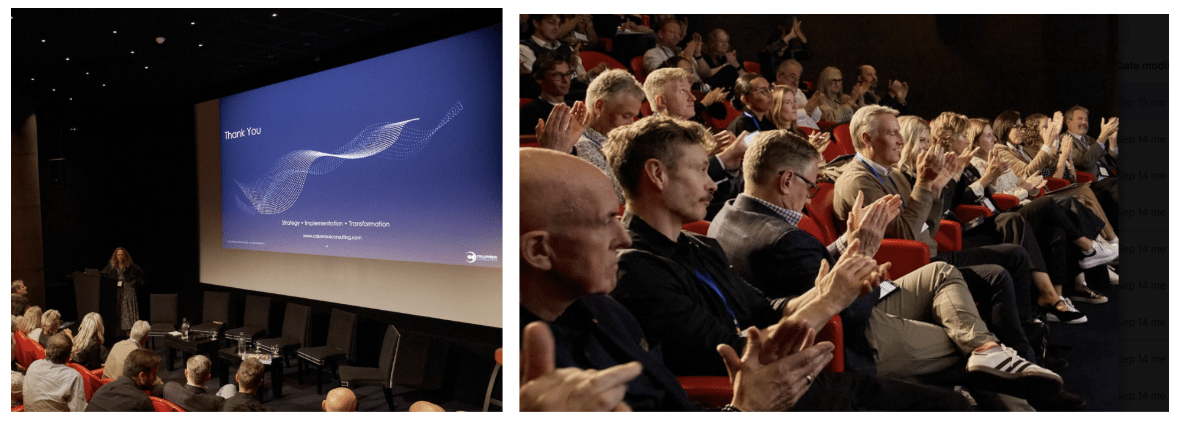
On September 10, 2026, Columbus Consulting brought together retail leaders, technology innovators, and industry experts at Columbus Circle LIVE! London for a morning focused on the forces reshaping retail — from artificial intelligence and intelligent inventory to leadership, technology, and the evolving Gen Z consumer.

The event featured perspectives from Columbus Consulting, leading technology partners, retail and industry experts, and researchers from the University of the Arts London (UAL) / London College of Fashion. Across the morning, a common theme emerged: the future of retail will be defined by how effectively organizations connect people, data, technology, processes and consumers.

The Future of Retail: From Connected Retail to “Retail Autopilot”
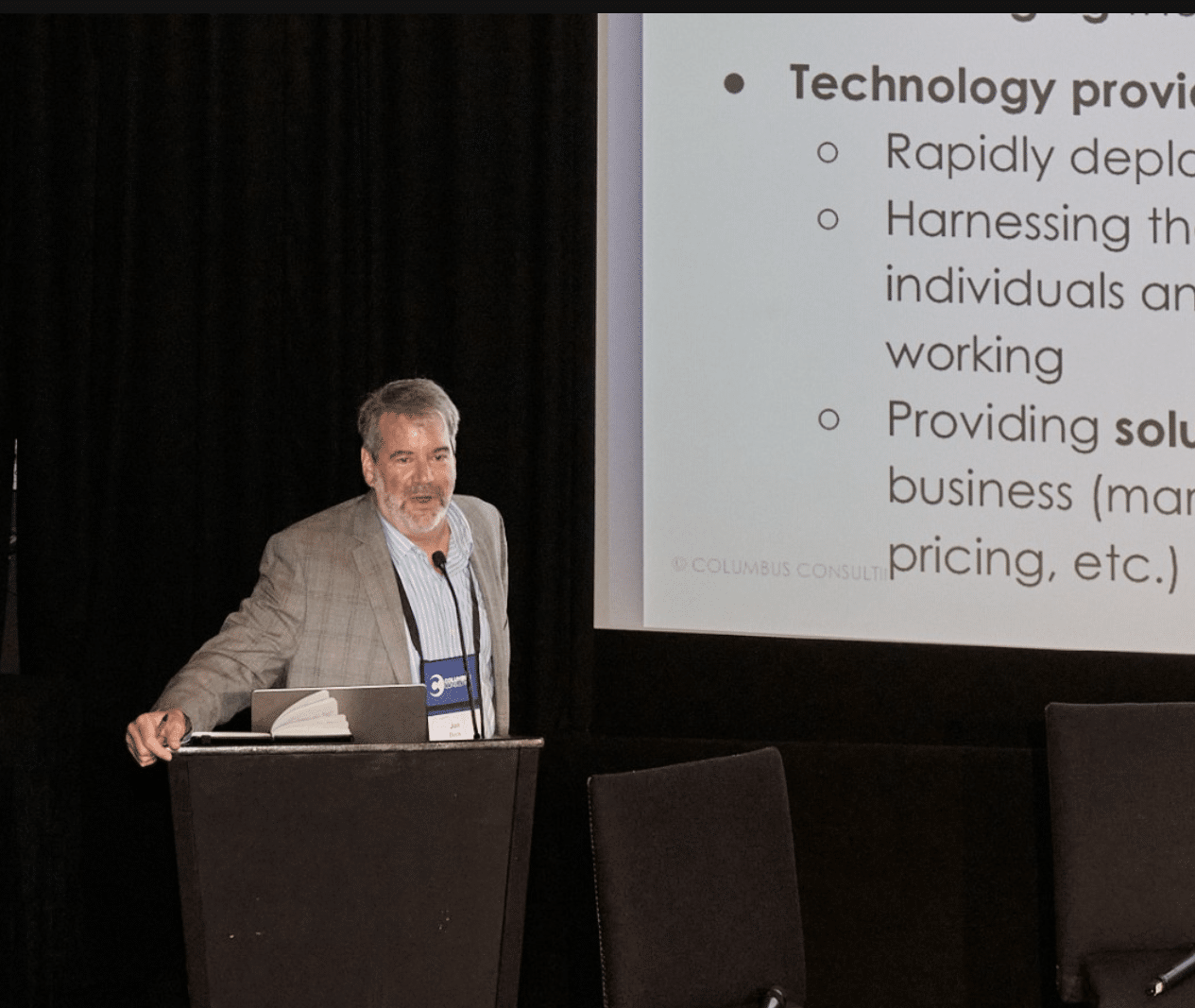
Jon Beck’s trends presentation explored how retailers and brands are seeking deeper connections across the entire retail ecosystem — with consumers, suppliers, partners, technology providers and their own organizations.
AI and technology are enabling new proactive and reactive, workflow-driven connections that were previously difficult to achieve. Jon framed this evolution as a path toward “Retail Autopilot” — a more automated retail environment with fewer manual interventions, better-informed decisions and greater use of data to drive desired business outcomes.
Getting there, however, requires retailers to address some fundamental organizational and technology challenges. Companies are cleaning up data hierarchies, attributes and definitions; aligning business processes around desired outcomes; rolling out data platforms and AI to end users; and rethinking roles, responsibilities and job descriptions. At the same time, the relationship between Business and IT is evolving, with technology organizations themselves changing how they operate.
Early Progress with AI
One of the most significant areas of early AI progress highlighted by Jon was demand forecasting. AI is increasingly capable of producing forecasts accurate enough to manage fashion and seasonal merchandise in ways historically associated with basic-stock replenishment.
The potential impact is significant. Many retailers still rely on highly manual and complex processes, including Excel-based solutions, to support planning and forecasting. More advanced AI-driven forecasting could simplify these processes while enabling pricing, promotion and clearance strategies to become much more integrated. The longer-term implication is a retail organization with fewer manual support roles and greater automation.
The Challenge: Moving from AI Experiments to Enterprise Transformation
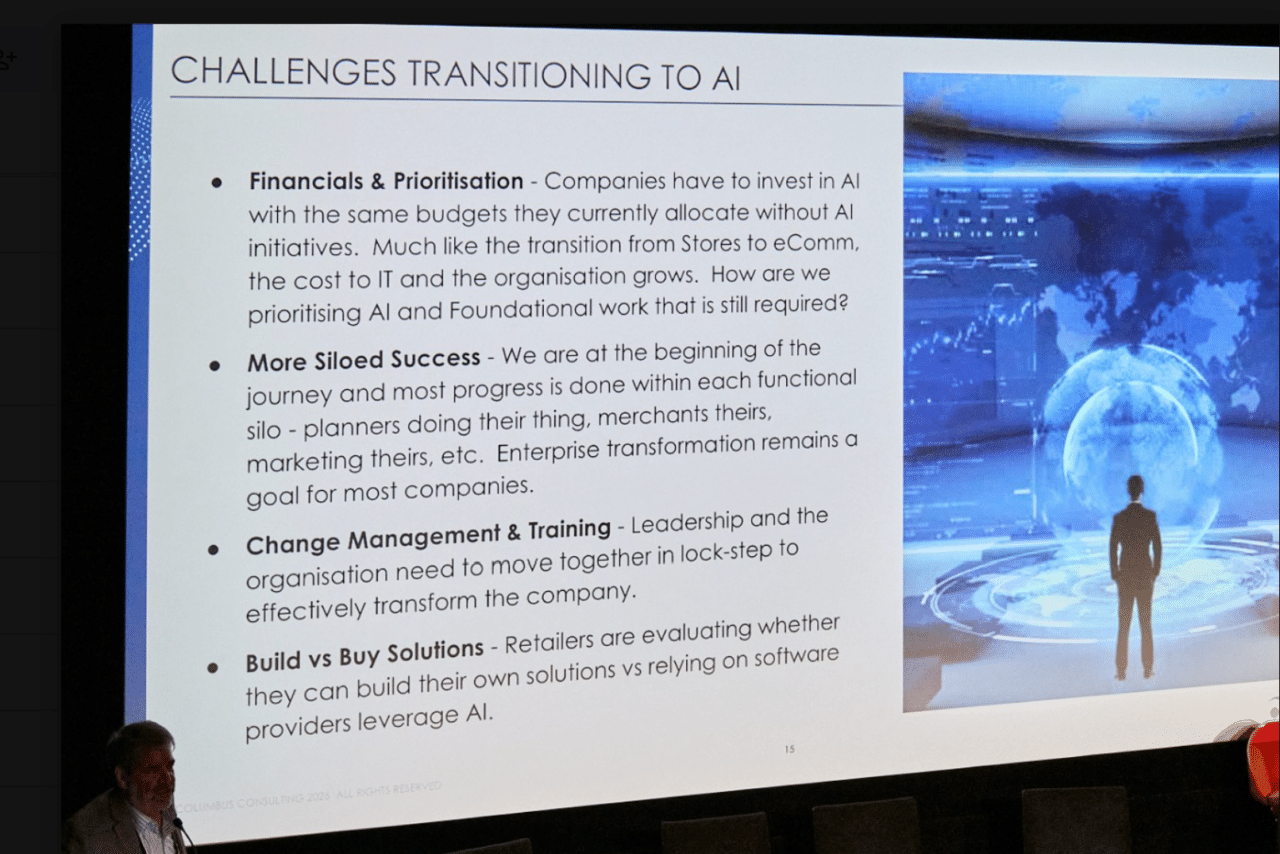
Jon also addressed the realities of activating AI across a retail organization. Retailers are facing four major challenges:
- Financials & Prioritisation — Companies need to fund AI while continuing to invest in foundational technology, data and capabilities. Determining which AI opportunities and foundational investments should receive priority is becoming increasingly important.
- More Siloed Success — Much of the early progress with AI is occurring within individual functions. Planners, merchants, marketers and other teams are each experimenting with AI, but connecting those successes into true enterprise transformation remains a goal.
- Change Management & Training — Technology alone does not create transformation. Leadership and the broader organization need to move together as roles, processes and ways of working change.
- Build vs. Buy — Retailers are also weighing whether to develop their own AI solutions or leverage the rapidly expanding capabilities of software and technology providers.
- The broader message was that AI’s greatest potential will come from connecting data, technology, processes and people across the enterprise, rather than deploying isolated tools within individual functions.
Inventory Optimisation Using Innovative Technology
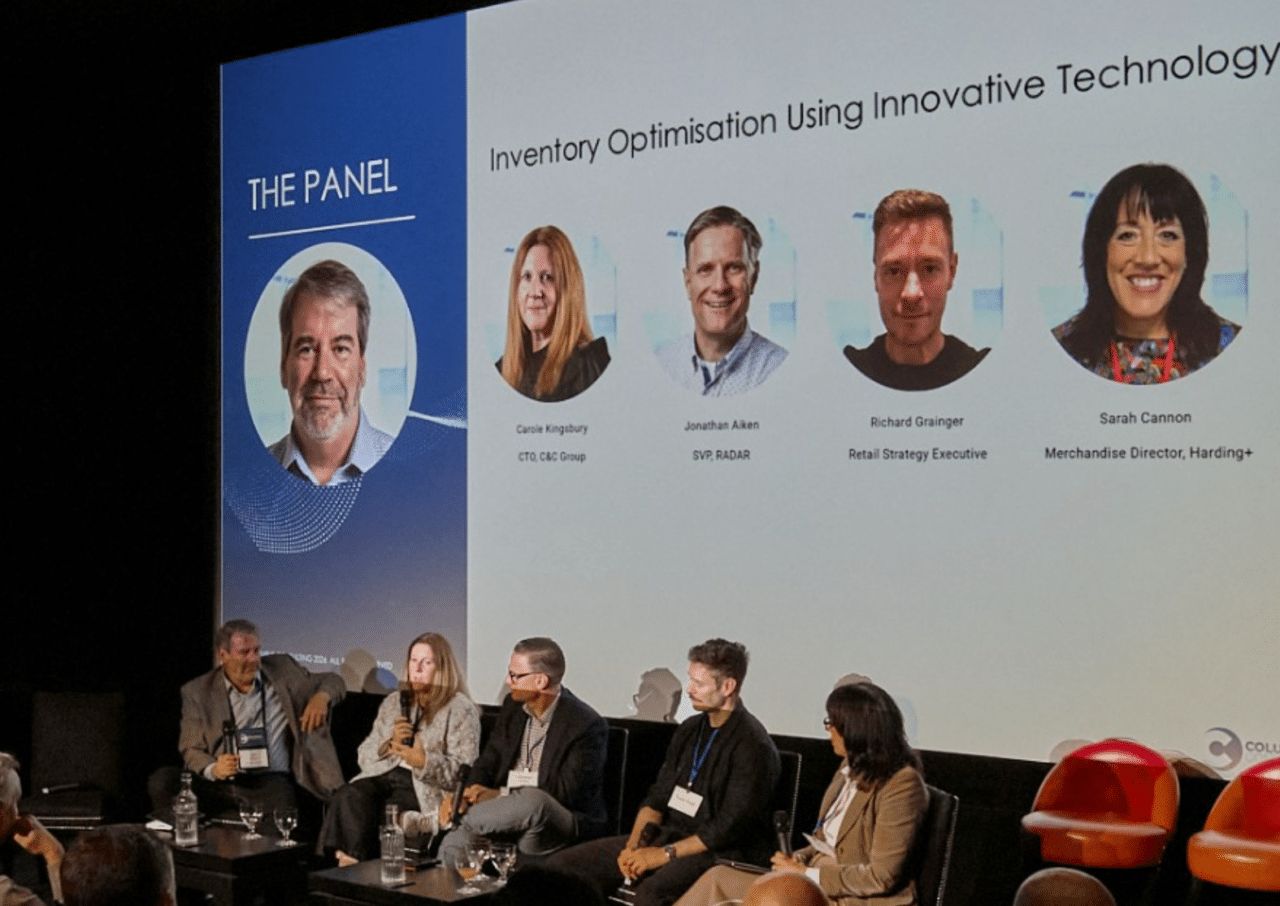
The discussion continued with a panel focused on Inventory Optimisation Using Innovative Technology, examining how retailers can use new technologies to improve inventory performance and decision-making.
The panel reinforced one of the central themes of the day: technology is becoming increasingly important in helping retailers make faster, more informed decisions while improving the connection between inventory, customer demand and business outcomes. The session provided an opportunity to explore how innovative technology can move retailers beyond traditional, manually intensive inventory processes.
Leadership in Tough Times

The leadership discussion featured Andy Jasper, Group Chief Executive Officer of The Eden Project, in conversation with Andrew Jennings OBE, exploring the theme “Sharing Leadership Skills in Tough Times.” The Eden Project is far more than a visitor attraction: it is a pioneering environmental education charity and social enterprise that has transformed a former clay mine in Cornwall into a globally recognized destination focused on nature, education, regeneration and positive action for the planet. Since opening in 2001, Eden has welcomed more than 25 million visitors and has become a powerful example of how an organization can combine purpose, innovation, commercial thinking and community impact.
For Andy Jasper, the conversation was particularly relevant to the theme of leadership through change. Having first joined Eden in its early years as Head of Research and Evaluation, Jasper returned as CEO in 2024 after senior leadership roles with the National Trust, Royal Horticultural Society and National Tropical Botanical Garden in Hawaii. His experience spans organizational transformation, major capital projects, horticulture, visitor experiences and sustainable growth.
The fireside chat offered a valuable perspective on what it takes to lead an organization through periods of uncertainty and transformation while maintaining a clear sense of purpose. Eden itself has had to navigate significant challenges while continuing to evolve and expand its mission. In that context, the discussion complemented the day’s broader retail themes: whether navigating AI transformation, changing consumer expectations or economic uncertainty, effective leadership requires organizations to remain adaptable, bring people with them through change, and stay connected to the outcomes and purpose that matter most.
The Gen Z Reality Check

The UAL / London College of Fashion research brought a consumer perspective to the conversation, examining how Gen Z is responding to brands, experiences, AI and sustainability.
Rather than presenting Gen Z as a single, predictable consumer group, the research explored the nuances behind their attitudes and behaviors — and challenged some common assumptions about younger consumers.
Experience Matters
Research presented under “From Experience to Influence” examined how experiential retail features influence visit intention, purchase behavior and cross-generational influence.
The research found that the overall shopping experience and store atmosphere were particularly important drivers of purchase and influence. It also found that Gen Z and Millennials showed the highest levels of cross-generational influence.
For retailers, the findings point to the continued importance of physical experiences that are distinctive, memorable and worth sharing. Pop-ups, engaging store environments and experiential retail can potentially influence not only the shopper in the moment, but also the broader social networks around them.
Authenticity Is Becoming the Baseline
The research also explored authenticity and Gen Z purchasing behavior, examining how consumers responded to positive and negative brand news.
Among the Gen Z respondents studied, positive brand news did not materially increase purchase intention, while negative news produced a meaningful decline. One implication from the research is that Gen Z may increasingly view ethical and responsible behavior as a baseline expectation, rather than something that automatically earns additional purchase consideration.
For brands, this creates an important distinction between simply communicating positive messages and demonstrating authenticity through consistent actions.

Gen Z, AI and the Customer Experience
Perhaps one of the most relevant findings for today’s retail environment came from the research examining “Winning Gen Z with AI?”
The study compared Gen Z and Millennials across AI-enabled advertising and shopping tools, including 198 participants — 107 Gen Z and 91 Millennials. The research found no major generational differences in attitudes toward AI, although Gen Z reported seeing more AI-enabled shopping features.
Importantly, greater exposure to AI did not automatically translate into higher purchase intention.
Instead, the research highlighted the importance of trust, transparency and practical value.
Familiar brands improved attitudes toward AI advertising, while clear AI labeling could reduce uncertainty and improve attitudes. AI tools such as recommendations and virtual try-ons were most compelling when they served a practical purpose and made the shopping journey easier.
The takeaway for retailers is that more AI isn’t necessarily better. The opportunity is to use AI where it genuinely improves the customer experience — helping shoppers discover products, make decisions and navigate the journey with less friction.
AI and Sustainability
The UAL research also explored the relationship between AI, sustainability and consumer attitudes. Participants evaluated AI-related advertising and sustainability information, with the research examining purchase intention and sustainable literacy.
The findings highlighted differences between Gen Z and non-Gen Z participants, including higher sustainable literacy among Gen Z in the study. The research also pointed to differences in attitudes toward AI by gender.
Overall, the research reinforced the importance of understanding why and how consumers respond to AI, rather than assuming that younger consumers will automatically embrace every new technology.

What the Gen Z Research Means for Retailers
Taken together, the UAL research offered a nuanced perspective on the next generation of retail consumers.
Gen Z is not simply looking for more technology. They are looking for experiences that feel relevant, brands that feel authentic and technology that provides genuine value.
For retailers, this creates several opportunities:
- Design physical and digital experiences that are memorable and shareable.
- Treat authenticity as an ongoing business practice rather than simply a marketing message.
- Use AI to solve real customer problems and reduce friction.
- Build trust through transparency around how AI is being used.
- Focus on utility and relevance rather than adding AI simply for the sake of innovation.
These findings connected directly back to Jon Beck’s broader trends discussion: the future of intelligent retail depends on creating better connections — between retailers and consumers, between data and decisions, and between technology and the people using it.
The Bigger Takeaway
Columbus Circle LIVE! London 2026 brought together three critical dimensions of retail transformation: intelligent technology, smarter inventory and changing consumer expectations.
The conversations reinforced that AI is moving beyond isolated experimentation toward broader changes in how retailers make decisions, structure organizations, connect functions and serve customers.
But the day also made clear that technology alone is not the transformation. Retailers must establish the right data foundations, align business processes and outcomes, rethink organizational roles, manage change and build trust with consumers.
The opportunity is to move toward a more connected and intelligent retail model — one in which data, people, processes and technology work together to create better decisions, stronger customer experiences and ultimately better business outcomes.
That is the path toward the next generation of retail — and toward Retail Autopilot.
For more on Columbus Consulting, the latest trends and insights and upcoming industry events, visit: https://www.columbusconsulting.com/
Thank you to our vendor sponsors/partners
