
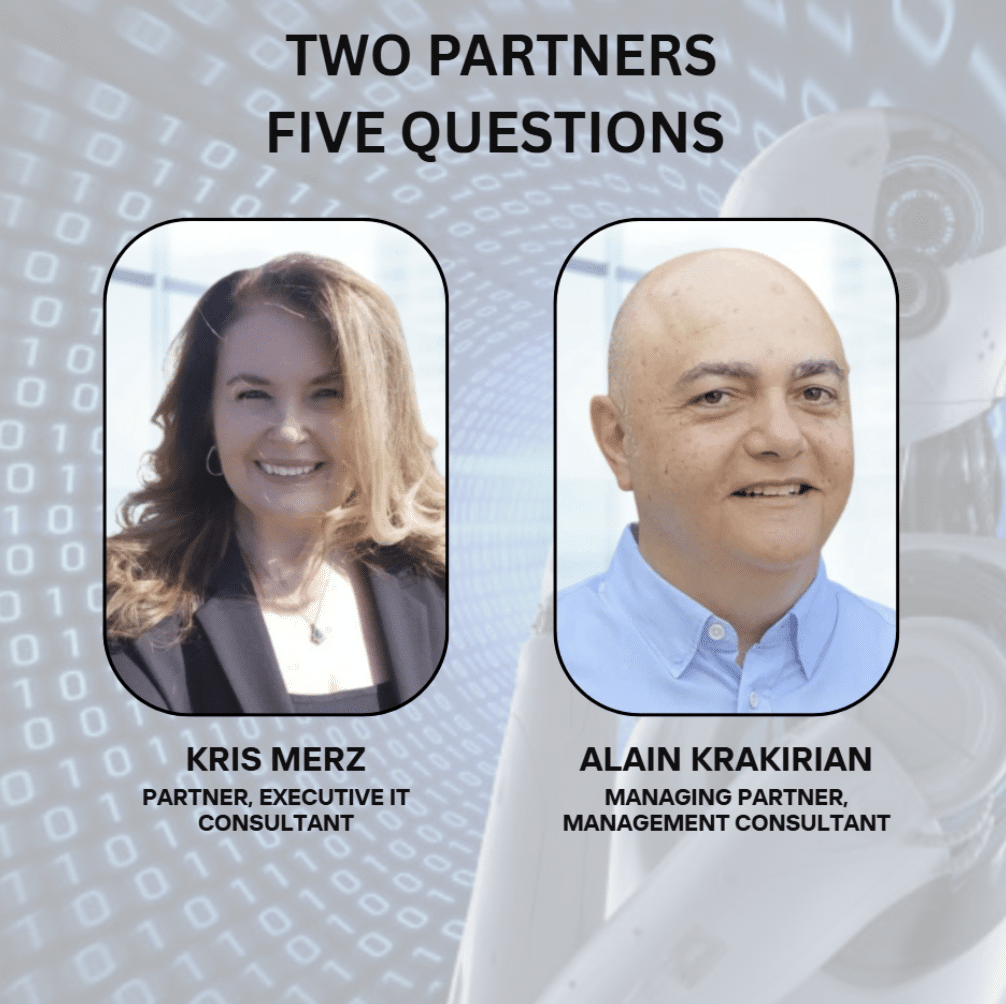
For over 25 years, Columbus Consulting has helped retailers drive transformation through many industry milestones. From the emergence of digital/social/mobile commerce to geo-political events like Covid and Tariffs, to unified commerce and agentic AI, our team of retail practitioners have navigated it all.
As part of our twenty-fifth anniversary, we explore what’s on the retail horizon with shared insights from two of our partners: Kris Merz and Alain Krakirian.
QUESTION ONE-ALAIN
Global commerce will continue to be impacted by increasing costs from wages to energy costs and continued tariff fluctuations. What changes do you see impacting margins over the next 12-18 months and how are retailers being advised to maximize profitability?
While it is difficult to predict market changes, the one constant is that retail is resilient.
Unlike years past, however, the industry does have advanced systems and tools to leverage and can now utilize an enormous amount of data for scenario planning. AI has enabled retailers to review their business in a more predictive manner–a pivot from reactive/historical planning. This advantages retailers to build avoidance strategies and mitigate risk. Having scenario planning in place can allow brands to better manage inventory levels (avoiding too much or too little stock levels) to maximize full price selling, hence, optimizing profits through higher margins.
Columbus Consulting works with clients to actively enhance planning systems and integrate AI to do just that. In addition, we look to cost reductions and logistical streamlining to build more efficient product development and supply chain performance.
One other consideration for retailers when managing through geo and economic shifts is to optimize promotions and pricing models. It really all does come down to selling the right product to the right consumer at the right time/place and at the right price.
QUESTION TWO-KRIS
Agentic AI is prominent across new headlines, what role, specifically do you see retailers applying AI-driven technology in the areas of assortment planning and allocation?
Agentic AI moves us beyond analytic dashboards and into systems that don’t just surface insights, they support, refine, and in some cases, execute decisions in real time.
When I think about the role of AI in assortment planning, I see it as an intelligence and optimization layer across the entire decision process.
In assortment planning, AI is shifting retailers away from static, historical models, from “what sold last year”, toward continuous evaluation of SKU productivity tied to contribution margin, not just top-line volume. It is also playing a critical role in enabling localized micro-assortments by store cluster, allowing retailers to respond to demand signals at a much more granular level.
In allocation, the role of AI becomes even more operational. Instead of periodic manual re-forecasting, AI can continuously rebalance inventory, identify risk
exposure before markdown windows open, and flag transfer or replenishment adjustments early.
The role is not to replace merchants. It is to augment them, freeing planners and merchants to focus on strategy, vendor partnerships, and long-range category vision while AI handles pattern detection, scenario modeling, and executional precision.
That shift, from periodic to continuous optimization, is where we are seeing the most value unlocked.
QUESTION THREE-ALAIN
From front-load to on-demand, inventory strategies have pivoted to respond to economic and consumer shifts, what is next on the horizon for optimal inventory planning?
Without sounding too redundant, artificial intelligence is empowering retailers to work differently–with speed and accuracy. Integrating agentic AI functionality into planning systems and throughout the organization allows for teams to be more strategic. Instead of spending time managing and reporting on data, teams can now spend more time reviewing data findings to implement more productive solutions that impact the business. Optimal inventory management is a critical area for productivity and profit; especially with seasonal and fashion assortments.
QUESTION FOUR-KRIS
Traditional search engines are fast being rivaled by AI agents/chat functions leveraging conversational commerce platforms. The industry is now evolving into the IOT (internet of things) where Agents are making actual purchase decisions on behalf of the consumer. How do you see this impacting brands?
This is one of the most profound shifts we’ve seen.
As AI agents begin making decisions on behalf of consumers, the battleground shifts from marketing persuasion to the data signals that influence AI-driven recommendations.
Retailers must ensure that product differentiation, pricing transparency, and availability are clearly interpretable by machines, not just humans.
AI agents rely heavily on signals such as reviews, return rates, availability, price competitiveness, and fulfillment speed.
Brand equity will still matter but it will increasingly be interpreted through machine logic. Retailers that invest in strong product data governance and digital shelf accuracy will have a clear advantage in an agent-led commerce environment.
QUESTION FIVE-ALAIN
What major shifts do you see happening in retail assortments, specifically in the US with aging boomers, cultural shifts and weight loss drug use, among other market conditions?
Every so many years we see pivotal shifts in the market that definitively change consumers, shopping behavior and business models. From ecommerce and social shopping to agentic AI and conversational commerce, retailers have learned to adapt. Retail has always been hard and it is getting harder. Sizing shifts are becoming more prevalent with the growing use of GLP-1 drugs. Traditional sizing scales are being challenged, leaning more into the mid-lower sizing end of the spectrum.
In addition, we continue to see the influence of cultural preferences in assortments–colors, fits, styles and ceremony/religious traditional specific needs. And, while marketers are fast focused on the next emerging generation, the aging market is still among the largest segments. Consumers are aging but staying active, so designers are adapting to the needs of seniors and staying aligned with modern textiles and apparel developments. As a result of all of these changes, assortments and allocation strategies are becoming increasingly more important.
More insights here: https://www.columbusconsulting.com/category/insights/
ABOUT COLUMBUS CONSULTING
For over 25 years, Retailers and Brands have relied on Columbus Consulting’s industry expertise, proven methodologies and program leadership to transform businesses. Our global team works across functional areas to shape and deliver desired results with tangible returns.
From Retail for Retail…We are experienced retail operators who have ‘sat in the same seats’ as our clients. Today, we operate as extensions of the client, bringing expertise and bandwidth to execute programs. Consulting teams are curated for each client, leveraging our deep retail expertise and talent.
Columbus Consulting remains at the forefront of the retail industry. As retail continues to evolve with AI, our team of experts provide insights and solutions to advance each client’s performance and profitability. We know what challenges they face and have a track record with over 400 retailers.
We work across all retail segments from Luxury to Big Box, Apparel to Grocery. Our expertise includes: digital transformation & unified commerce, merchandising & category management, planning & inventory management, sourcing & supply chain, data & analytics, accounting, finance & operations, people & organization and information technology & artificial intelligence. From strategy to implementation, let us know how we can help. columbusconsulting.com